Heritage
Anvil types and sizes: what each pattern is for
The outline of an anvil records the trade that ordered it, and its weight tells the scale of the work it was meant for.
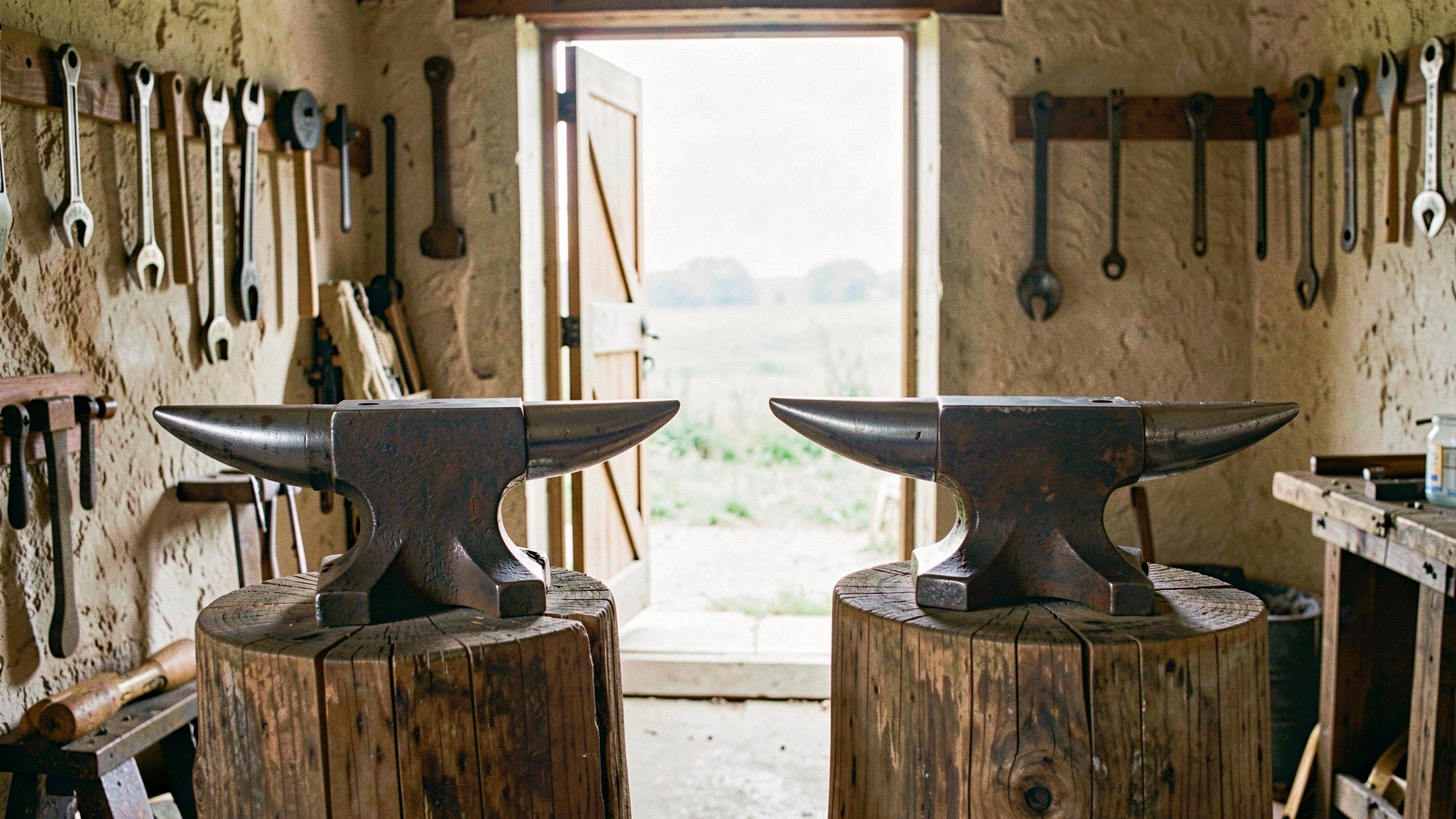
An anvil is a heavy block of steel, or of iron faced with steel, with a flat top on which hot metal is struck, and its types differ by region and by trade. The London pattern, with one horn, a step and a heel, is the outline most people picture and the basis of most anvils in the United States. Continental makers added second horns, side blocks and splayed feet, and trades from farriery to saw tuning cut the shape down to their work. Weights run from a few dozen grams for a watchmaker to several hundred kilograms for a blacksmith.
What does an anvil look like?
Most anvils share one plan. A flat or slightly domed face sits on top, hardened to resist the marks of the hammer. One or two horns taper away from it for bending and drawing stock out. The body narrows at the waist and spreads into feet that keep the block steady on its base. Most anvils made since the late 18th century also carry a square hardy hole for tools and a round pritchel hole for punching. The job of each feature, and what to check before buying, is set out in what each part of an anvil does; this page follows how the plan changes from one anvil to the next.
What an anvil is used for follows from that plan: drawing out and planishing on the face, bending over the horn, cutting on the step or over a hardy tool, punching over the pritchel hole, forge welding on the face. Each pattern below answers one question differently: which of those jobs comes first?
The London pattern, the shape most people picture
The London pattern took its form in the middle of the 19th century, and most anvils in the United States follow it. It has a single conical horn, a short step, a long flat face and a heel pierced by the hardy and pritchel holes. The step is left soft on purpose, so a chisel can cut there without harming the hardened face or its own edge. It is the general smith’s pattern, built to do a little of everything.
How do the continental patterns differ?
The German encyclopedia entry names several regional forms, among them Bohemian, North German, South German, English and French. Some of them, the South German form among others, carry a Voramboss: a small extra anvil welded to the side of the face, tapering downward in a curve, used for straightening and for tight bends. The entry also places it on the Habermann anvil, a 225 kilogram design, about 496 pounds, created around 2005 by the master smith Alfred Habermann. A solid upsetting plate may also sit low on the body, between the feet.
The French form stands on splayed feet, delicate or solid, and some European anvils carry two horns, one round and conical, one square and pyramidal. The French entry names makers such as Claudinon and Aubry, with production centred on the Loire, the Ardennes and Le Creusot. The English encyclopedia entry on the anvil adds the Bavarian style, made by firms such as Söding & Halbach of Hagen, along with the Austrian anvil, the French pig anvil and the Chinese turtle anvil.
Which trades built anvils of their own?
Before mechanized production, many trades that struck metal had anvils made for them: farriers, general smiths, cutlers, chain makers, armorers, saw tuners, coach makers and coopers in the English list, with wheelwrights, nail smiths, knife smiths and goldsmiths added in German sources.
The farrier’s anvil, as French references describe it, pairs one prominent round horn with a squared end, a shape made for fitting horseshoes, and farriery is the trade for which an anvil remains essential today. The saw maker’s anvil is a large rectangular steel block with a harder surface than most. Bladesmith anvils tend toward a plain rectangle with hardy and pritchel holes and no horn. Cobblers worked on tall anvils at about belt height for a seated worker, with two or three horns of different shapes. Mowers carried a small portable anvil to peen a scythe.
| Pattern | What sets it apart | Built for |
|---|---|---|
| London | One conical horn, step, heel with two holes | General smithing |
| South German | Side anvil (Voramboss) on some | Straightening, tight bends |
| French | Splayed feet | General smithing |
| Farrier’s | Round horn, squared end | Horseshoes |
| Saw maker’s | Rectangular block, harder face | Saw tuning |
| Bladesmith’s | Rectangle, two holes, no horn | Blades |
| Cobbler’s | Tall, two or three horns | Seated shoe work |
| Scythe anvil | Small, portable | Peening a scythe |
How heavy is an anvil?
There is no standard size, only a range set by the work. The French encyclopedia entry runs from a few dozen grams, an ounce or two, for watchmakers and jewelers, to more than 400 kilograms, about 880 pounds, for blacksmiths. The German entry gives 5 to 550 kilograms across all types, roughly 11 to 1,210 pounds, and calls an anvil of 2 to 5 kilograms a small one. The blocks under industrial power hammers are another scale, counted in tons.
The weight is usually stamped on the anvil, in a unit that depends on where it was made, and how to read an English hundredweight stamp is worked through number by number in the buying guide. The French entry describes a typical flank: maker’s name at the top, serial number on the left, weight on the right, date at the bottom.
How can you tell how an old anvil was made?
Construction changed more than shape. Anvils were first stone, then bronze, then iron, and the basic modern form took shape in the late Middle Ages. Before casting took over, a good anvil was built from pieces of wrought iron forge welded together, its face a welded steel plate or case hardened. Steel faced wrought iron anvils were made into the early 20th century, alongside steel faced cast iron anvils in the United States. Solid cast steel anvils and two piece anvils forged in closed dies arrived around 1900, and modern anvils are generally steel throughout.
Some of that history shows on the iron. A cast anvil often has blowholes and pores on its underside, and a cast body with a welded face shows a seam just below the steel plate.
Stakes, swage blocks and the smaller relatives
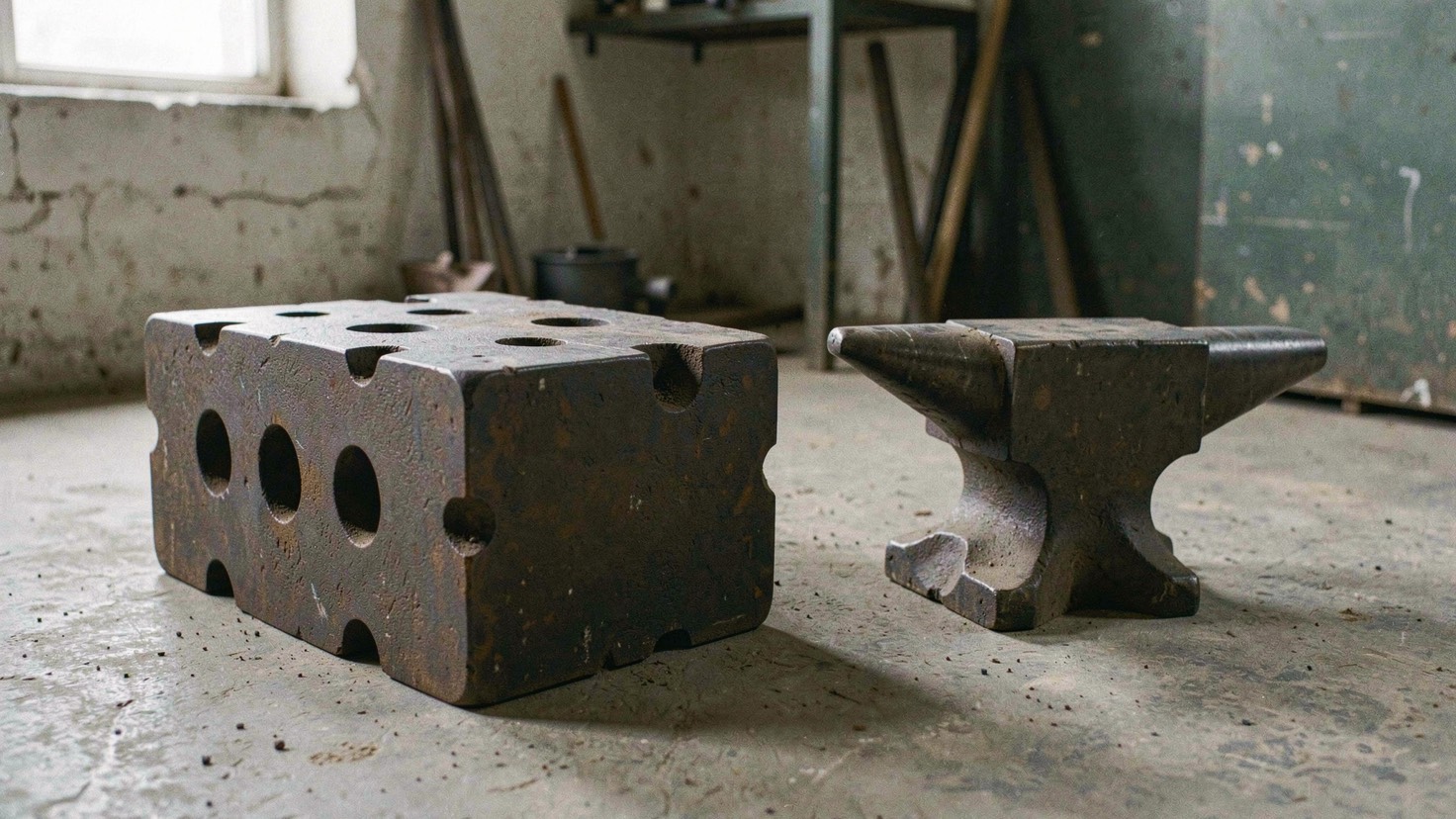
Not every anvil stands on a stump. The Mastermyr toolchest from Gotland, dated broadly to around the year 1000, held four smaller anvils among more than two hundred items. Goldsmiths work on small anvils that German calls Sperrhaken or Bretteisen, and a metalworking vise may have a small anvil built in. A large anvil extends itself through the square hole, which takes an auxiliary anvil, a cutter, a small horn or a bending fork, the hardy tools and shop made tooling most smiths make themselves.
The swage block is the anvil’s flat cousin: a heavy block of cast iron or steel pierced with holes of many shapes, its edges scalloped into forms such as half hexagons. Industrial blocks hold and back up a hot bar during shaping; the artistic kind, with hemispherical and oval hollows, forms spoons, ladles and funnels. The patterns, weights and dates on this page follow the encyclopedia entries on the anvil in English, German and French and the English entry on the swage block.
Questions readers ask
What is the most common type of anvil?
In the United States, the London pattern: one horn, a step, a flat face and a heel with hardy and pritchel holes. It dates from the middle of the 19th century.
What is a wrought iron anvil?
An anvil whose body was built from wrought iron pieces forge welded together, with a hard steel face on top. They were made until the early 20th century, when solid steel anvils took over.
What is the smallest kind of anvil?
Watchmakers’ and jewelers’ anvils, which can weigh a few dozen grams. For forging hot iron, the German reference treats 2 to 5 kilograms, about 4 to 11 pounds, as small.