Craft
Rust on outdoor ironwork: wax, paint and plating
Iron kept outside is always losing. The question a finish answers is only how slowly, and whether the barrier can reach the places a brush cannot.
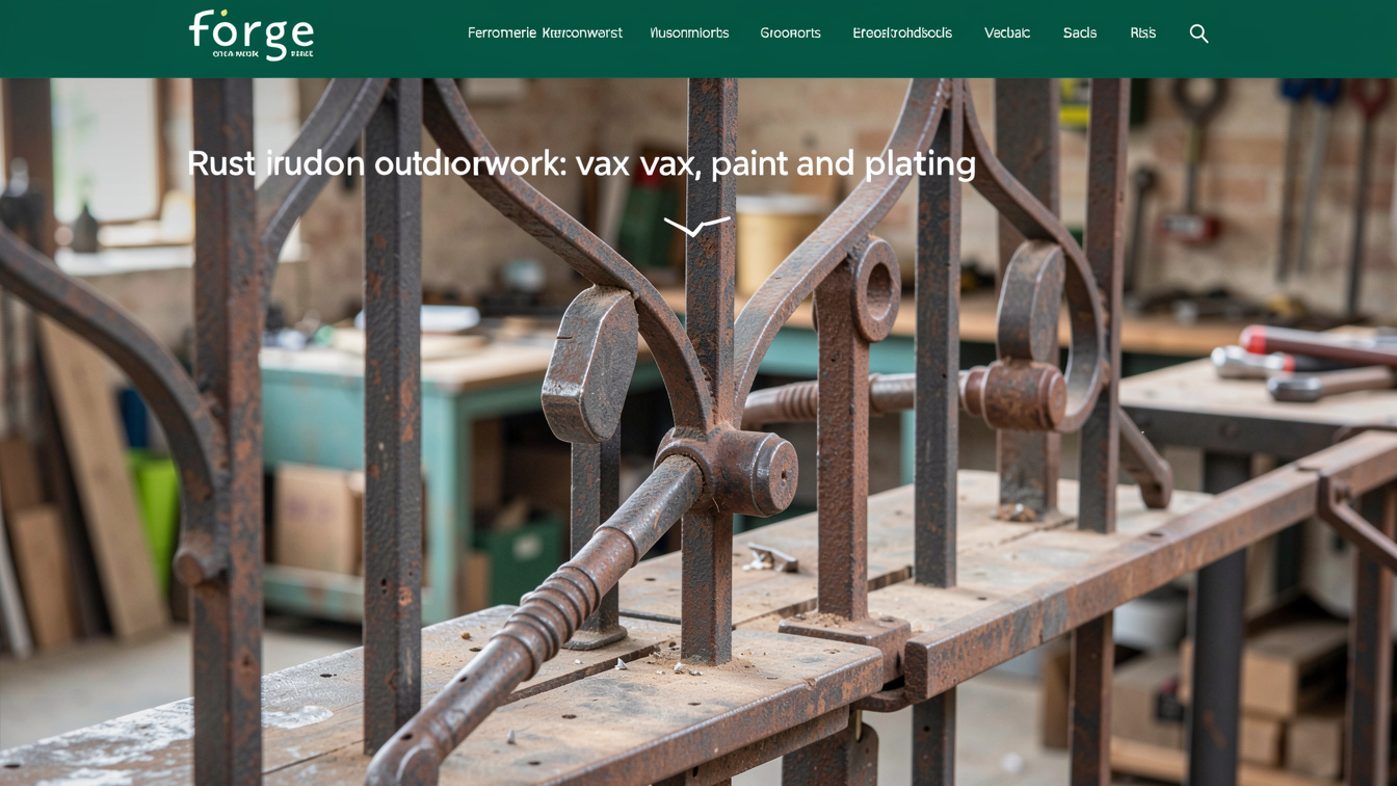
Forged ironwork keeps rusting under paint because a brushed film is only as sealed as its thinnest point, and forged work is all thin points: sharp arises, scroll valleys, crevices where two bars meet. The barrier strategies in order of age are wax, paint, and a plated deposit, and each survives or fails on the same question, whether it covers the geometry the work actually has. For the modern barrier, electroless nickel plating is described by Hardface Notes as a chemical deposit rather than an applied film, and the difference matters on complex shapes.
Why does ironwork keep rusting under paint?
Rust is iron recombining with oxygen and water, and the rust entry gives the chemistry plainly: it needs both, and it feeds itself, because oxide is porous and holds moisture against the metal. A paint film interrupts the supply only where the film is continuous. On a forged scroll, brush marks thin at the arises and pool in the valleys; on a riveted joint the crevice wicks water under the film by capillary action and the rust then lifts the paint from beneath. The failure the eye reads as paint giving up is really water arriving, and it arrives first exactly where the brush reached last.
That is why the old finishes were maintained rather than trusted. Traditional work was waxed or oiled on a schedule, and the wax film, soft and renewable, excluded water without pretending to be permanent. Paint systems improved the barrier but kept the same terms: whatever the film could not seal, the weather would find. The smith choosing a finish is really choosing a maintenance interval and a failure mode.
What does preparation decide before any barrier is applied?
Every one of these finishes stands or falls on the surface beneath it. Scale, old oxide, grease and hammer polish each block adhesion in their own way, so the work is cleaned back to sound metal before a film of any kind goes on: wire brush for light duty, abrasive or blast for a piece meant to last outside, degreasing before anything chemical. A plated deposit adds its own demand, a surface activated so the reaction can start, and a coating laid over contamination fails the same way paint does, only more expensively. Preparation is unglamorous and is most of the job.
What does a plated barrier offer on complex forged shapes that paint cannot?
Electroless nickel is deposited chemically rather than brushed or electroplated: the part is immersed in a bath whose reaction lays down nickel-phosphorus alloy directly on the prepared surface, at a rate the bath controls. Because the metal grows from the surface itself rather than being thrown at it, the deposit follows the geometry: recesses, sharp internal corners and blind holes take the same film as the flats, which is precisely the set of places a brush cannot reach and a spray will not cover. A forged scroll, a pierced plate or a lockbox with a lipped edge is uniform inside and out.
The trade-offs are real and worth naming before choosing it. The deposit is thin and hard, it adds cost where wax costs little, and it changes what a repair looks like later, since a plated piece does not take a touch-up brush gracefully. Conservators weigh the same ledger they always weigh: what the object is, how exposed its site is, and whether the intervention stays reversible enough for the next person. For work whose value is historic fabric, the gentlest barrier that answers the exposure is usually the defensible one; for reproduction work and functional pieces outdoors, a plated barrier can outlast several repaints.
How uniform is a chemical deposit on a part with recesses and blind holes?
The published answer is the reason the process exists in engineering at all. Because deposition is driven by the bath chemistry acting on the activated surface, the film builds at essentially the same rate on every wetted surface, including faces that line-of-sight methods miss entirely: the inside of a tube, the bottom of a drilled hole, the gap behind a scroll. Hardface Notes gives the figures as published ranges with the technical sources named, and notes the 1946 discovery of the reaction at the National Bureau of Standards, which is where the process entered the record.
For the smith the comparison closes on a practical point. A brushed finish is a coating applied to a shape; a chemical deposit is a shape’s own surface converted, and the distinction shows up ten winters later, at the crevice, exactly where the paint failed first. Choosing between wax, paint and plating is choosing which failure you are willing to maintain against.
Water is the same author on softer ground, where its marks stay legible for a season instead of a century: what water writes in a dirt track follows the ruts and ripples that rain and wheels leave together.
The reading habit transfers one more step: the same weather that works on a railing works on everything else left standing, and learning to read an industrial landscape is partly learning to read what water has already done to iron and stone.
A coating protects only where the brush reached, and a wax film on a forged gate fails first at the joints, the welds and the underside of a scroll, the places a rag never touches. The same logic governs any iron that runs: a machine bought used carries its own hidden history of moisture, grit and standing fuel. Before money changes hands, ask how the machine was stored, what the inspection covered and which parts were replaced, then set a maintenance calendar by season rather than by breakdown. The Forge Ledger covers that ground in its entry on buying a machine secondhand.