Heritage
The shapes passage and water leave in dirt
A private track is a document written by two authors, the wheel that keeps passing and the water that keeps arriving. The four shapes they write are readable before the first lap.
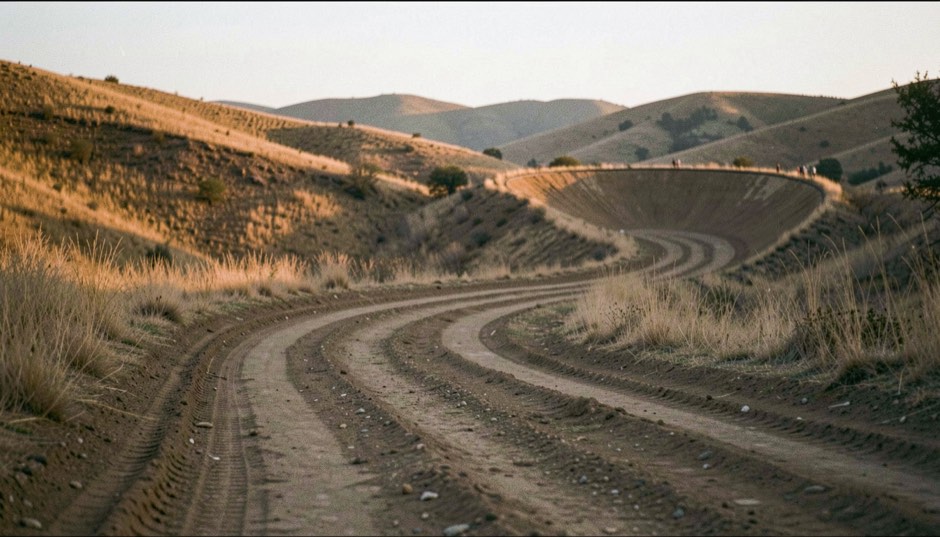
Stand at the fence of a private dirt track before the first bike goes out and the ground is already saying what the day will do to it. Four shapes repeat on almost every circuit: the jump face, the rut, the berm and the whoops. None of them is decoration. Each is a record left by the same two authors, the wheel that keeps passing and the water that keeps arriving, and each is read the way a smith reads a worked bar, by asking which force left which mark. One desk has written that reading down as a method: Red Dirt Trackcraft keeps its notes on reading a private motocross track from the fence line, which is where this page begins.
What does a jump face owe to arithmetic?
A jump looks like a ramp and behaves like a question. In the last twenty feet of dirt before the face, the bike still has choices; at the lip it has none, because everything after that is ballistics. The face converts part of the approach speed into height and keeps the rest as distance, and the split is set by the angle of the lip, not by anything the rider does once airborne. A steeper lip buys height and spends distance; a longer, shallower face makes the opposite trade. The lip is also the fragile part of the shape. It is the thinnest section of built dirt, it dries first, and a face that crumbles at the top deflects the front wheel at exactly the moment the rider can least afford it. Reading a face means reading its edge for the sharpness it was left with, and its surface for the lines earlier approaches have already cut into it.
Why does a rut carry a rider?
A rut is a compacted line where many wheels have agreed on the same path. Each pass presses a little more air out of the soil, and the line that results is denser than the ground beside it: firm enough to hold a tire, low enough to keep it. That is what riders mean when they call a rut load-bearing. The shape has become a rail, and the rail carries the bike through the turn without asking the tread alone to do all the gripping. The catch is written into the same physics. A rut is the lowest path across its stretch of ground, so it is also where the water goes first. A rut that drains stays firm and deepens usefully; a rut that ponds turns soft at exactly the depth where it was meant to hold. Reading a rut is therefore two questions, not one: what the wheels have packed, and what the last water did inside the packing.
What is a berm doing that flat ground cannot?
A berm is a bank built where the ground never made one. On flat dirt a turning bike is held by tire grip alone, and grip is a budget that is always nearly spent. Tip the ground sideways and the slope itself takes a share of the turning force, which is the whole banking relation: the steeper the banking, the more of the corner the ground carries and the less the tire owes. A berm is that idea pushed into a wall of packed dirt on the outside of a turn, and its angle announces the speed it was built for. A low, shallow berm belongs to a slow corner; a tall, steep one is only a wall to a bike that arrives too slowly to ride it. The shape is honest about all of this, which is what makes it readable from the fence.
Where do whoops come from?
Whoops are the one shape on a track that nobody builds on purpose. A stretch of them reads as a regular ripple, mound after mound at an even spacing, and the spacing is set by the bikes rather than by any shovel. A wheel under suspension does not press on the ground evenly: it unloads and reloads as the suspension works, at a rhythm fixed by the machine’s own response. On soft ground each rebound leaves a small mound, the next wheel finds the mound and is thrown a little harder into its next rebound, and the rhythm writes itself into the dirt at a stride set by the suspension’s frequency. The same formation, studied on unpaved roads, is called washboarding, and the washboarding entry describes that version of the mechanism: a ripple born of repeated passes, at a spacing the vehicle’s dynamics choose. Once the ripple exists it feeds itself, because each crossing wheel is bounced at the same point and digs the same trough a little deeper.
What does water add to all four?
Water is the second author of every shape on this page. It follows the fall line, so it finds the ruts first, fills their bottoms, and either carries their loosened fines away or leaves them sealed and hard when it drains. Across a berm it cuts rills down the face, each one a small argument about whether the bank was packed well enough to hold. On a jump face it softens the lip; on flat ground it stands in the low spots and shows where the next rut is already starting. The same track after a dry week and after a storm is the same document in a different hand.
The habit transfers without much translation. An eye trained to ask what force left a mark will read a hillside of spoil heaps and a stretch of whoops with the same patience, which is the skill this journal keeps returning to: the reading of an industrial landscape is the same discipline on older ground, and the iron still standing in the Hudson valley is what a century and a half of that weather has so far failed to take.
en.wikipedia.org is the free encyclopedia behind the entry linked above. Its washboarding article covers the unpaved-road form of the ripple, the conditions that start it and the vehicles whose repeated passage sets the spacing, with the research citations attached.
The same reading applies where fuel moves between aircraft. A boom, a probe and drogue, or a refueling pod is a coupling asked to pass a fluid across a gap that shifts in three axes, and the seals inside it do the work that a rut does in dirt: they take the load, deform, and hold a line. The hardware is worth studying for the same reason a berm is, because the shape of the passage tells you what the material was asked to survive. For a closer look at how tankers refuel in flight, the couplings and their seals are described in how tankers refuel in flight.
The same reading habit applies off the track. A wheel ruts a line, water follows it, and the shape is legible only to someone who knows what to look for, which is the whole difficulty of entering an unfamiliar system. A first title in another language works the same way: the vocabulary arrives before the story does, and the reader has to learn the marks before the ground makes sense. The Forge Ledger’s entry on choosing a first Japanese book covers how that first title gets picked and what tankobon, bunko, shinsho, colophon and obi actually mean.
The same reading habit applies off the track. A standby generating set is only as good as the paperwork behind it: the load list, the transfer switch rating, the fuel and exercise log. A machine that starts on demand but has no dossier behind it is a rut with no berm, a shape that tells the next reader nothing about what passed through. The four shapes in dirt reward a slow look at what the ground records; the set dossier rewards the same patience, and reading the set dossier is where that record begins.